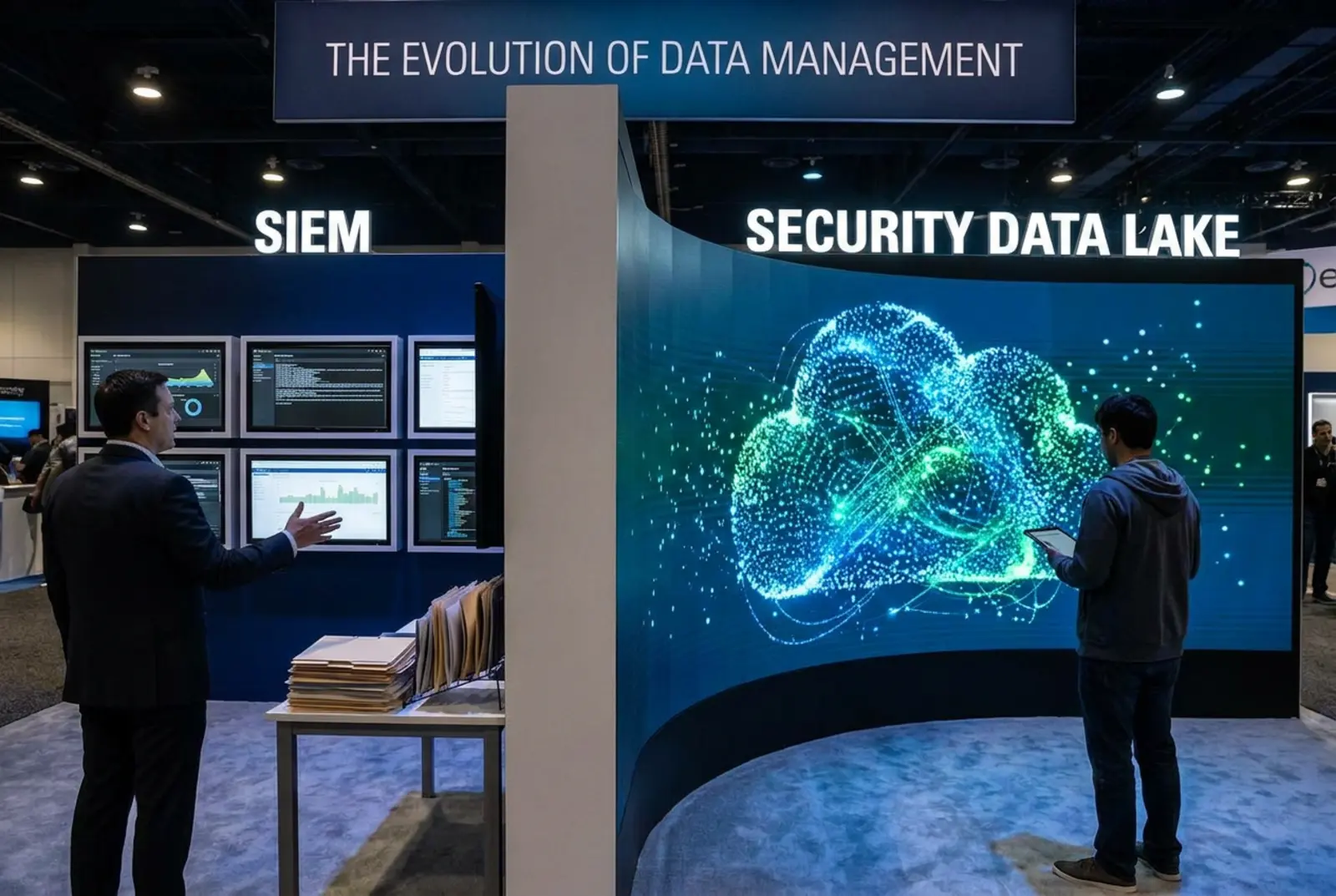
A siloed SIEM misses cross-system fraud because it only sees security logs. A 2 a.m. login from a new country looks routine until you see the vendor bank change in the ERP an hour later. A security data lakehouse puts normalized logs beside ERP and CRM tables, so one query catches both.
Here is the pattern, built on synthetic data. A remote user signs in at 2 a.m. from an IP address in a country they have never used. The identity provider logs a clean authentication. An hour later, someone changes a vendor’s bank routing number in the ERP. Ten minutes after that, a large invoice gets approved.
Each event looks routine on its own. Together, they look like fraud. The SIEM saw only the first one.
That blind spot is expensive. IBM’s 2026 Cost of a Data Breach report puts the average time to identify and contain a breach at 247 days, up after five straight years of decline. That is more than eight months. In my experience, a big share of that time goes to analysts stitching evidence together from consoles that were never built to talk to each other.
Cybersecurity at this point is a data engineering problem, not a tooling problem. Fix where the data lives and the detection follows.
Why does a 2 a.m. login go unnoticed before an ERP bank change?
Hold that sequence against a day-in-the-life baseline for the user and it jumps off the page. This person works business hours, signs in from one country, and has never touched vendor master data. Three breaks from the baseline in 70 minutes is a signal. That baseline is what machine learning anomaly detection learns from, and it only works when the model sees identity, HR and ERP history together.
A traditional SIEM never sees the baseline. It ingests identity provider logs, records a successful login, and moves on. Even a dedicated identity threat detection and response (ITDR) tool sees only the identity half of the story. The ERP change log never arrives, because finance records don’t fit the vendor’s security schema and cost too much to ingest.
The attack crosses three systems. Your detection has to cross the same three.
What makes a siloed SIEM miss cross-system threat detection?
The miss isn’t bad luck. It comes from six design choices that compound over time.
- The data lives apart. Security events go to the vendor’s cloud. ERP and CRM data go to a separate warehouse. Analysts can’t join across the two.
- Ingestion pricing punishes context. Many SIEMs price by data volume. Teams filter out application logs to keep the bill in check, and the context goes with them.
- Short retention leaves audit gaps. When every gigabyte costs money, teams cut how long they keep logs. Auditors and incident responders then ask for history nobody kept.
- Proprietary schemas block joins. Security data locked in a vendor format won’t join cleanly with HR, ERP or CRM tables.
- Fragmented data starves machine learning. Anomaly models need long, joined history for every user. Split between a vendor cloud and a separate warehouse, that history never comes together at the scale the models need.
- Alerts without context bury the real ones. Every odd login fires an alert. Zero Trust programs verify every access request, which adds identity events by design. Without business context, the SOC drowns in false positives and starts tuning out the quiet signals that matter.
Here is the SIEM vs security data lake comparison on the factors that decide cross-system detection.
| Factor | Traditional SIEM | Security data lakehouse |
|---|---|---|
| Data context | Security and network logs only | Security logs beside ERP and CRM data |
| Who holds the data | The vendor’s cloud | Your own cloud account |
| Cost model | Often priced by ingestion volume | Storage you own plus the compute you run |
| Retention | Often shortened to control ingestion cost | Long history in object storage you own |
| Schema | Proprietary vendor format | Open standards such as OCSF |
| Machine learning | Limited to the vendor’s built-in models | Models trained on joined security and business history |
| Detection | Rules without business context | Correlation across security, ERP and CRM tables |
How does a security data lakehouse close the context gap?
You close it by moving security logs onto the same platform as your business data. I’ve spent more than 30 years implementing enterprise systems inside IBM, Ernst & Young, Johnson & Johnson and McKesson. The lesson repeats: when technical data and business data live apart, nobody sees the whole picture.
On Databricks, the build follows the medallion layers:
- Bronze: Auto Loader streams raw identity logs, firewall logs and network telemetry into Delta tables as they land.
- Silver: Parsing jobs normalize every source to the Open Cybersecurity Schema Framework (OCSF), so a login from Okta and a login from Entra ID share one shape.
- Gold: Views join OCSF authentication events with ERP vendor master changes, HR termination lists and CRM account records.
Unity Catalog governs access across all three layers, so security analysts see the finance columns they need and nothing more. The gold view connects the 2 a.m. login to the bank change that follows an hour later. One query, full context.
Why treat security as a data engineering problem?
Start from first principles. Your logs are your data. Paying a vendor to hold a partial copy, in a format you can’t join, makes little sense. At Analytics AIML, our Databricks data engineering work starts there: you keep the storage layer, and you run analytics on top of it.
I’m a Lean Six Sigma Master Black Belt, and I look at a security pipeline the way I look at a production line. Every extra copy of the data is waste. Every proprietary parsing step is a place for defects to hide. An open lakehouse removes the redundant ingestion pipelines.
The same discipline shapes orchestration. We build LakeFlow pipelines with a Lean Six Sigma lens: if a step doesn’t add detection value, it comes out.
How do you prove the model works small first?
You don’t need a big-bang migration to prove the value. Start with one pilot and one question.
Our own homemade test, run on synthetic data, missed 3 planted attacks. The detection rules had nothing to correlate against. Once we joined the identity logs with simulated HR and CRM tables, all 3 attacks stood out.
A later security pilot on governed data found 4 real issues in 770,000 events. Four needles, and the haystack was the point. Under per-gigabyte pricing, most of those events get filtered out before anyone looks at them.
How does Lakewatch run detection as code?
Security data lake fraud detection works best when detection rules are code. Your data engineers write SQL or Python that scans the lakehouse on a schedule or a stream. The rules live in Git, get tested like any other code, and deploy through Databricks Asset Bundles.
Lakewatch is our prototype of the agentic SIEM pattern, built on dummy data. It applies AI-driven cross-system threat detection with a human kept in the loop. An agent reads security signals beside the ERP and CRM tables. When it flags a login, it pulls the surrounding records, builds a timeline of the user’s activity, and drafts an incident summary for a human analyst.
That is Lean Six Sigma applied to the security operations center. The agent automates the evidence-gathering half of incident response. The analyst spends their time on the call that matters: contain or clear. For the full build, read our Lakewatch write-up.
What does it cost to pay twice for a silo?
The cost case is as strong as the security case. Most mid-market teams pay twice and get a silo. They pay a cloud provider to store their enterprise data. Then they pay a SIEM vendor a premium to ingest a fraction of that same data into a separate cloud.
That is a toll for looking at your own logs. A Databricks lakehouse removes the toll. You store the data once, in your own cloud account, and pay for the compute your detection queries use.
Two mechanics keep that compute lean. Auto Loader processes only new files, so you aren’t rescanning history on every run. Materialized views keep SOC dashboards fast without copying raw logs into another tool.
If you’re evaluating a Databricks lakehouse implementation partner, ask one question first: will my security data sit next to my ERP and CRM data when you’re done?
Is your SIEM bill already making the choice for you?
Pull three numbers: your monthly SIEM ingestion bill, the log sources you filter out to control it, and the cross-system questions your SOC can’t answer today. Then weigh these drivers:
- Filtered logs. If your team drops application logs to stay under budget, you have outgrown ingestion pricing.
- Cross-system fraud and anomaly detection. If payments, vendor master data or customer accounts are targets, your detection needs ERP and CRM context.
- Team skills. Detection as code needs engineers comfortable with SQL, Python and Git.
- Data ownership. If you want your security history in open formats you control, the lakehouse wins.
Our line at Analytics AIML is Secure. Solve. Scale. Secure the data foundation first. Solve one cross-system question with it. Then scale detection across the business, right next to the data it protects.
If your SIEM bill is forcing you to choose between cost and context, start with one cross-system detection. Our lakehouse security services build governed threat detection pipelines on Databricks, from OCSF normalization to gold-layer correlation. Contact us to scope the first pilot.
Frequently Asked Questions (FAQs)
What is the difference between a SIEM and a security data lake?
A SIEM is a vendor application that ingests security events and alerts on them, usually in a proprietary format. A security data lake stores security logs in open formats you own. On a lakehouse, those logs sit beside ERP and CRM tables, so you join them for cross-system detection.
How does security data lake fraud detection work?
Detection rules run as SQL or Python against gold views that join security events with business records. One rule flags a new-country login followed by a vendor bank change within hours. Neither event alone triggers it. The combination does.
How do AI and machine learning improve security data lakehouse detection?
Models need history and context, and the lakehouse keeps both in one governed place. Machine learning learns each user’s normal pattern from joined identity, HR and ERP history, then scores departures from it. An agent, like our Lakewatch prototype on dummy data, gathers the surrounding records and drafts a timeline. A human analyst makes the call.
Can a security lakehouse replace an existing SIEM?
For many teams, yes, in stages. Move long-term retention and cross-system correlation to the lakehouse first, where you store data once in your own account and the business context already lives. Retire SIEM functions as detection-as-code pipelines prove they cover the same use cases.
How does a Lean Six Sigma approach reduce cloud SIEM costs and improve threat detection?
It treats the security pipeline as a process. Copying logs into redundant vendor clouds is waste, so you store the data once in your own lakehouse and pay for the compute your detection queries use. Failing to connect an identity log to an ERP transaction is a defect, so you fix the joins before any AI goes on top.