Most mid-market teams should not fine-tune first. Start with prompting, then retrieval-augmented generation (RAG) on governed lakehouse data. Fine-tune on Databricks AI Runtime only when a model must hold a strict output format, a fixed tone, or a narrow vocabulary that prompting and RAG fail to deliver reliably at production volume.
Databricks made AI Runtime generally available on October 21, 2026, and managed GPU training on the lakehouse is now one job submission away. That makes fine-tuning easy to start and just as easy to regret. The trouble arrives later: a serving bill that runs every month, training data nobody can trace back to its table, and a model that learned the errors in your source data. For a mid-market data team, the question is no longer whether you can train your own model. It’s whether you should.
In 30-plus years of implementing enterprise systems inside IBM, Ernst & Young, Johnson & Johnson and McKesson, I’ve watched one pattern hold. New capacity tempts teams to skip the question of whether they need it. Fine-tune a model on a messy silver layer and you bake the mess into the weights.
What Does This Decision Come Down To?
- Databricks AI Runtime gives you managed, serverless GPU compute for model training.
- Start with prompt engineering, not custom training.
- Add RAG when the model needs your facts.
- Fine-tune only when the model needs a new behavior: a strict output format, a fixed tone or a narrow vocabulary.
- Keep training data, logs and checkpoints governed in Unity Catalog.
- Run the AIM-IT Assess step to prove the business case before anyone books GPU time.
Why Do Enterprise GenAI Pipelines Miss The Mark?
Before you configure a single Databricks GPU training job, look at why these builds break. The failures repeat, and almost none of them are about the model.
- Dirty inputs from the bronze layer: Teams feed raw, unstandardized text straight into training. Sloppy data engineering produces a model that is confidently wrong.
- Confusing facts with behavior: This is the fine tuning vs RAG boundary. Teams spend weeks teaching a model company facts that belong in an index it reads at query time.
- Training outside governance: When a data scientist trains on a laptop, lineage disappears. Nobody can tell an auditor which dataset produced which model version.
- Leaking data across a hybrid setup: Prompts carrying customer or patient records go to an outside API, or a training extract lands in an ungoverned cloud bucket. No accuracy gain makes up for that privacy gap.
- Forgetting the inference bill: A fine-tuned model needs a serving endpoint. Teams budget the one-time training run and miss the monthly hosting cost.
- Underestimating LLMOps: A fine-tuned model is a system you run, not a file you ship. Evaluation sets, retraining jobs, version promotion and drift checks become permanent engineering work, and skipping them builds debt you pay later.
- Locking into one model provider: Build every workflow around one proprietary API and you inherit its pricing and its deprecation schedule. An open-source model you fine-tune and host keeps that choice with you, at the cost of running it yourself.
- Automating a broken process: Faster compute on a bad workflow produces bad results faster. The Lean Six Sigma rule applies: fix the process first.
For the broader pattern, read our breakdown of why AI pilots fail.
What Is Databricks AI Runtime?
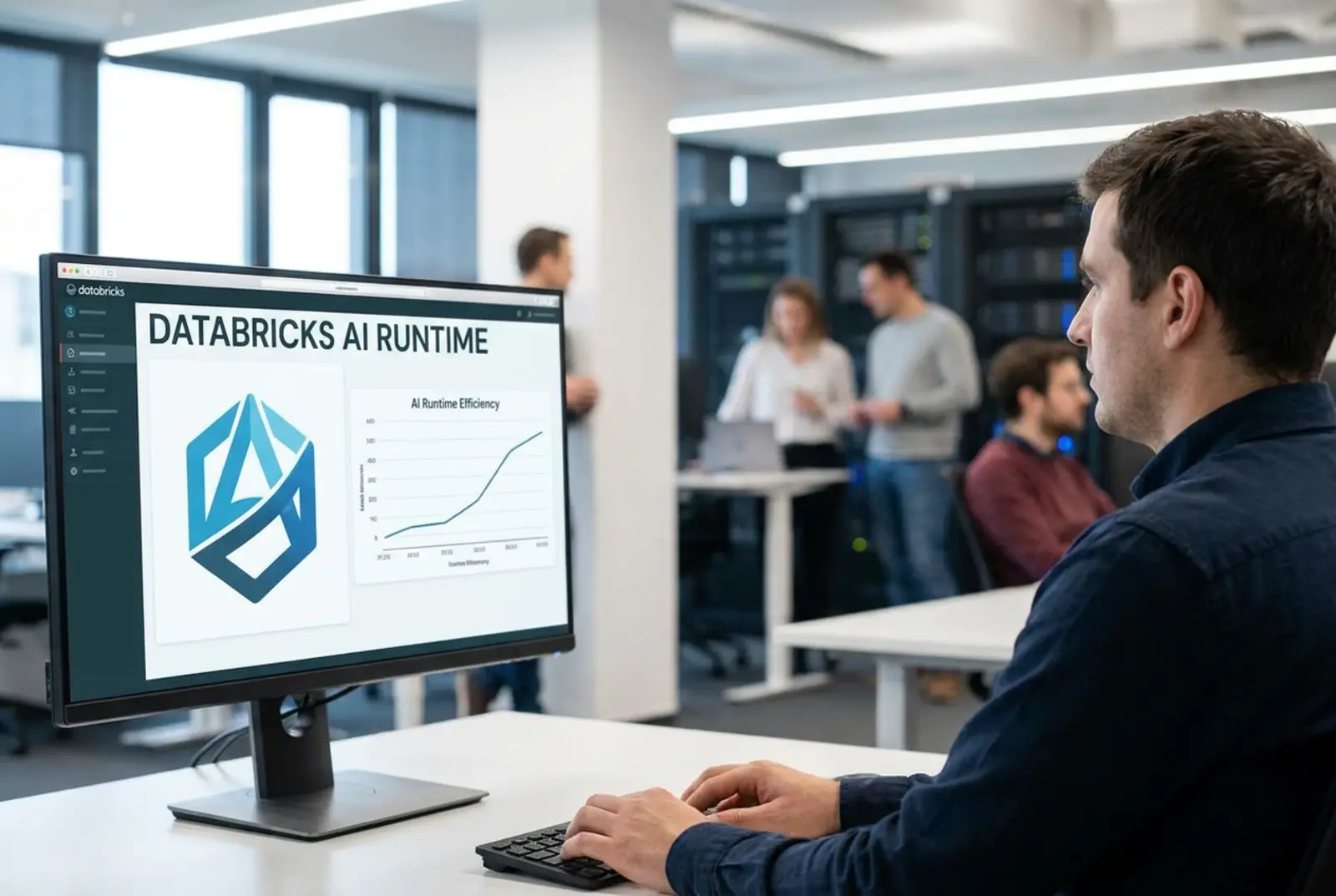
Databricks AI Runtime is managed, serverless GPU compute for Databricks model training and customization, and it takes much of the LLMOps infrastructure work off your team. Your team submits a training job. The platform provisions the GPUs, runs the job and releases the hardware when it finishes.
That removes a real burden. Nobody on your team manages Kubernetes clusters, pins GPU driver versions or untangles dependency conflicts. In the same announcement, Databricks names Robinhood, Merck and FactSet as adopters.
For a mid-market team, the appeal is lower operational overhead. Your engineers spend their time on training data quality and evaluation instead of idle servers. Because the runtime sits inside the lakehouse, training data, logs and checkpoints stay under the same Unity Catalog governance as the rest of your data.
When Does Fine-Tuning Actually Beat Prompting And RAG?
The fine tuning vs RAG call is the most important architecture decision in this process. I tell clients to climb a ladder. Start with prompting. Move to RAG when the model needs your data. Fine-tune only when you hit a limit neither one fixes.
Fine-tuning wins when a smaller model needs to learn a specific behavior. Three examples:
- Writing SQL against a proprietary internal schema.
- Returning strict JSON for a legacy API.
- Classifying records with a specialized clinical or technical vocabulary.
These are behavior changes. A model trained for one narrow decision, like a classification node in a workflow, doesn’t need a frontier LLM behind it. A smaller model trained for that one job runs faster and costs less per call.
RAG wins when the goal is knowledge. If the model needs last quarter’s financial reports, training is the wrong tool. You refresh a RAG index when the documents change, with no retraining. For the cost side of that choice, see our guide to enterprise RAG implementation cost.
| Approach | Best For | Compute Cost | Maintenance Burden |
|---|---|---|---|
| Prompt engineering | Proving basic viability and tone | Lowest | Minimal |
| Retrieval-augmented generation (RAG) | Grounding answers in your private, current data | Moderate | Medium |
| Fine-tuning on AI Runtime | Teaching strict formats, syntax, tone or vocabulary | High, plus monthly serving | High, with ongoing LLMOps |
How Does Unity Catalog Govern Training Data, Logs And Checkpoints?
Speed is not the main reason to train on the lakehouse. Lineage is. With AI Runtime, your training data, run logs and model checkpoints live under Unity Catalog, the same governance layer that already controls your tables.
That gives you three controls. When your team logs the training dataset with each run, every registered model version traces back to the table and Delta version that produced it. Training jobs read data under the same Unity Catalog permissions as everything else, so a model only learns from tables its builders are allowed to see. And you decide exactly who can query each serving endpoint.
This is what shuts down shadow AI and keeps sensitive records from drifting into ungoverned copies. It matters most in healthcare and financial services, where an auditor will ask which data shaped which decision. For a related build on the same governance layer, see our breakdown of Databricks Agent Bricks.
What Cost Questions Should You Ask Before Training?
Custom models are expensive to build and expensive to keep running. Before you approve a Databricks GPU training run, put it through the AIM-IT framework: Assess, Innovate, Model, Implement, Track. The Assess step does most of the work, and it is where GenAI cost control actually happens, so ask these questions there.
- Which metric moves? Name it. Human review time cut by 20 percent? Latency down from three seconds to 500 milliseconds? No number, no compute budget.
- Have prompting and RAG actually failed? Ask for the evaluation results that prove it.
- Is the training data clean? If the silver layer still has duplicates and mismatched keys, fix that first.
- What does serving cost each month? Compare per-query cost against a commercial API, then add the dedicated endpoint, which bills whether or not anyone calls it.
- Who retrains it? Your data changes. Someone owns the retraining schedule and the evaluation set, or the model drifts.
Low query volume is where the math breaks. If traffic can’t keep a dedicated endpoint busy, the hosting bill erases the savings.
When Should You Build Instead Of Buy?
Mid-market teams can’t afford to chase trends. Buying access to a commercial foundation model is the right starting point for almost every new project. You get immediate scale and zero infrastructure to run.
Building your own model with Databricks model training makes sense in two situations. First, privacy or contract rules forbid sending payloads to an outside provider. Second, your query volume is high enough that per-token pricing costs more than running your own endpoint.
Apply first principles thinking here. Strip the decision down to cost per correct answer, data risk and who maintains the model. Decide on what the business needs, not on what the infrastructure makes possible.
Which Training Path Fits Your Mid-Market Team?
Run this decision tree before anyone books GPU time:
- Does a well-written prompt on a commercial model meet your quality bar? Ship it and stop here.
- Does the model fail because it lacks your facts? Build RAG on governed lakehouse data.
- Does it still fail on format, tone or vocabulary after RAG? Fine-tuning is now on the table.
- Is your training data clean, governed and versioned in Unity Catalog? If not, fix the data engineering first.
- Does the AIM-IT Assess step show a metric that pays for training plus monthly serving? If yes, run it on Databricks AI Runtime. If no, stay on RAG.
At Analytics AIML, we put the data and the process right before anyone trains a model. We secure the data, solve the process, then scale the model: Secure. Solve. Scale. If your team is weighing fine-tuning on the lakehouse, see how we take AI on the lakehouse into production.
Frequently Asked Questions (FAQs)
What is Databricks AI Runtime?
It is managed, serverless GPU compute for training and fine-tuning models on the Databricks lakehouse. Databricks made it generally available on October 21, 2026. You submit a job, and the platform handles the hardware.
How does Databricks AI Runtime compare to OpenAI or Anthropic APIs?
They meet different needs. A commercial API from a provider such as OpenAI or Anthropic gives you a hosted model you pay for per token, with no infrastructure to run. AI Runtime gives you serverless GPU compute to fine-tune a model, often an open-source one, that you then serve from your own endpoint. You pay for the training run rather than idle GPUs, but the endpoint bills monthly. Start with an API, and move to AI Runtime when privacy rules or steady query volume justify owning the model.
Can we fine-tune on data already in our lakehouse?
Yes. Training reads from tables governed by Unity Catalog, so your existing permissions apply. Log the dataset with each run and you keep lineage from silver table to model version.
How is fine-tuning different from RAG?
RAG retrieves your documents at query time and leaves the model unchanged. Fine-tuning changes the model’s weights to teach a behavior, such as a format, a tone or a vocabulary. Use RAG for knowledge and fine-tuning for behavior.
How does Analytics AIML handle GenAI governance and ROI on Databricks?
We start with the AIM-IT Assess step: name the metric the model must move and the monthly serving cost it has to beat. Then we build the lakehouse pipelines and Unity Catalog governance that keep training data, run logs and checkpoints traceable to a model version. If the numbers don’t support fine-tuning, we recommend staying on RAG.