— AI readiness and opportunity assessment · The first step of your consultation
AI readiness and opportunity assessment: find the build before you fund it.
An AI readiness assessment and an AI opportunity assessment are the same discipline here, and the first step of a larger consultation, not a standalone product. We map the process, measure the baseline and carry the result straight into the rest of the engagement, not a report that sits in a drive.

30+ years inside IBM · EY · J&J · McKesson
Lean Six Sigma Master Black Belt
AIMSolve from $2,500
60-Day Ship Guarantee
— The pattern · Three failure modes
Three ways an AI assessment goes nowhere.
01
A deck, not a build
The assessment ends in a slide deck ranking opportunities by impact and effort. Nobody owns the next step, so the deck is read once and filed.
02
No measured baseline
Without a baseline for cycle time, error rate or cost, the business case for the first build is an opinion. One real example: a manual design proofing process running 7.2 business days per order with a 15% error rate across more than 500 orders a season, measured before anything was proposed.
03
Readiness asked twice
A readiness question and an opportunity question get run as two separate projects, with two separate bills, when they are one conversation about the same process.
— The work · What the assessment covers
An AI readiness and opportunity assessment that ends in a scoped build.
The assessment is Lean Six Sigma and first-principles redesign applied to your backlog, not a maturity survey, and it opens the consultation rather than closing it. It decides what is ready to build, in what order, before we quote anything larger.
Value stream mapping
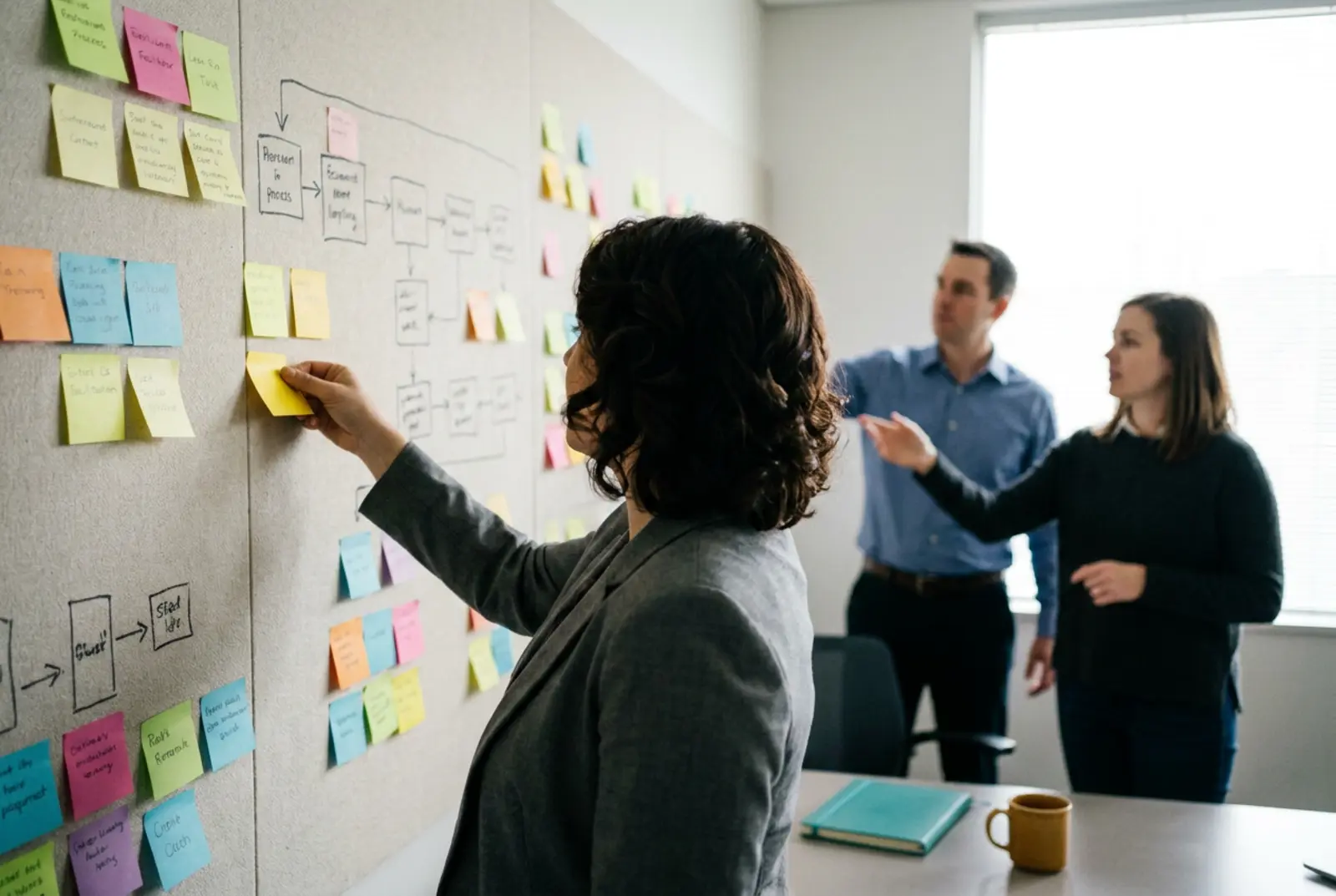
We walk the candidate processes with the people who run them and map every hand-off, wait and rework loop, so the real workflow is on paper before anything is scored.
Measured baseline
Cycle time, defect rate and rework measured on real work for each candidate, so the opportunity list is ranked on a number, not an opinion.
First-principles redesign
We ask what each workflow would look like if you designed it today, and remove steps before automating any of them.
Readiness against the lakehouse
What each candidate needs from your data (source access, governance, quality) before it can be built, checked against what the lakehouse already has.
A prioritised, scoped build list
Candidates ranked by measured impact and effort, with the first one scoped in enough detail to quote a fixed price.
Control plan
Owners, measures and review dates for the first build, written down before it starts, so the gain can be checked afterward.
— Why one assessment, not two
Readiness and opportunity are the same question.
Whether you are ready for AI and where the first build should land both come from the same walk-through: map the process, measure the baseline, and see what the lakehouse data can support. Splitting that into a separate readiness review and a separate opportunity review doubles the meetings without doubling the answer.
If you want to see the method before booking, our own template and guides are the AI opportunity assessment template, the AI readiness assessment guide and the mid-market version.
— The method · AIM-IT
DMAIC scores the opportunity. AIM-IT ships the build.
Assess, Innovate, Model, Implement, Track. AIM-IT carries the assessment straight into the first build, so the ranking and the roadmap are not two separate documents.
01 · ASSESS
Assess
Current-state map and baseline
Walk the candidate processes, measure the baseline, and find where the defects actually start.
02 · INNOVATE
Innovate
Future-state workflow
Redesign the leading candidate from first principles, removing steps before automating any.
03 · MODEL
Model
Pilot results against baseline
Pilot the new flow on real work and compare it to the baseline in numbers.
04 · IMPLEMENT
Implement
Rolled-out process and automation
Roll out the redesigned process and the automation together, with the people who run it.
05 · TRACK
Track
Control plan
Owners, measures and review dates, so the gain holds after we leave.
— The deliverable · What you get
What you own at the end.
- A current-state process map with a measured baseline for every candidate assessed.
- A redesigned future-state workflow for the leading candidate, steps removed before anything is automated.
- A prioritised opportunity list, ranked by measured impact and effort, not by guesswork.
- A scoped build for the first candidate, specific enough to quote a fixed price.
- A written control plan: what is measured, how often, and who owns it.
1 to 2 wks
Typical first build
5 phases
AIM-IT, end to end
$2,500+
Starting price
60-Day
Ship Guarantee
On every Sprint engagement: if we don’t deliver the agreed working artifact in 60 days, you don’t pay the final invoice.
— Who runs it
Led by a Lean Six Sigma Master Black Belt.
Frank “Rio” Shines spent 30+ years implementing enterprise systems inside IBM, Ernst & Young, Johnson & Johnson and McKesson. He runs the assessment himself, on your real process, with your team, so they learn the method by doing it.
When the first build needs data behind it, the pipelines are scoped under data engineering, and any AI on top of it under AI on the lakehouse.

— Related reading · From the blog
Go deeper on readiness and opportunity.
Template
The AI opportunity assessment template
A charter format for scoring candidates by measured impact and effort.
Guide
What an AI readiness assessment actually checks
The readiness questions that matter before any build is scoped.
Mid-market
An AI readiness assessment for mid-market teams
Why the mid-market version skips the maturity survey and goes straight to the baseline.
Field guide
Don’t automate chaos: a field guide to AI process improvement
How to fix the workflow so the automation actually sticks.
Cost of skipping it
The big miss: deploying AI in broken processes
What it costs to automate before the process is measured.
Framework
AIM-IT: the 90-day framework from assessment to production
The five phases, and what each one delivers.
— Straight answers · The objections answered
Frequently asked questions (FAQs)
Is this assessment fixed fee, or billed by the hour?
Fixed fee. AIMSolve starts at $2,500 for a fixed-scope workflow charter and first build, as the entry step of the consultation. Larger programmes are quoted after the assessment, once the first candidate is mapped and measured, never billed by the hour.
What is the difference between an AI readiness assessment and an AI opportunity assessment?
Here, nothing. A readiness question (are we ready to build) and an opportunity question (what should we build first) come from the same walk-through of the process. AIMSolve answers both as the first step of one consultation, not two separate products.
What do we get besides a slide deck?
A measured baseline, a redesigned future-state workflow for the leading candidate, a prioritised opportunity list ranked by impact and effort, a scoped first build specific enough to quote a fixed price, and a written control plan. The slide deck is a summary of those, not the deliverable.
Can we run a readiness or opportunity assessment ourselves first?
Yes. Our own opportunity assessment template and readiness assessment guide walk through the same questions. Bring the result to the paid assessment and we validate it against a measured baseline, then move straight to a scoped build.
Who runs the assessment?
Frank “Rio” Shines, a Lean Six Sigma Master Black Belt with thirty years of delivering enterprise systems inside IBM, Ernst and Young, Johnson and Johnson and McKesson. He runs the assessment himself.
Start with the assessment, not the slide deck.
One call, your real backlog on the table, and the first step of a project engagement instead of a report that sits in a drive.