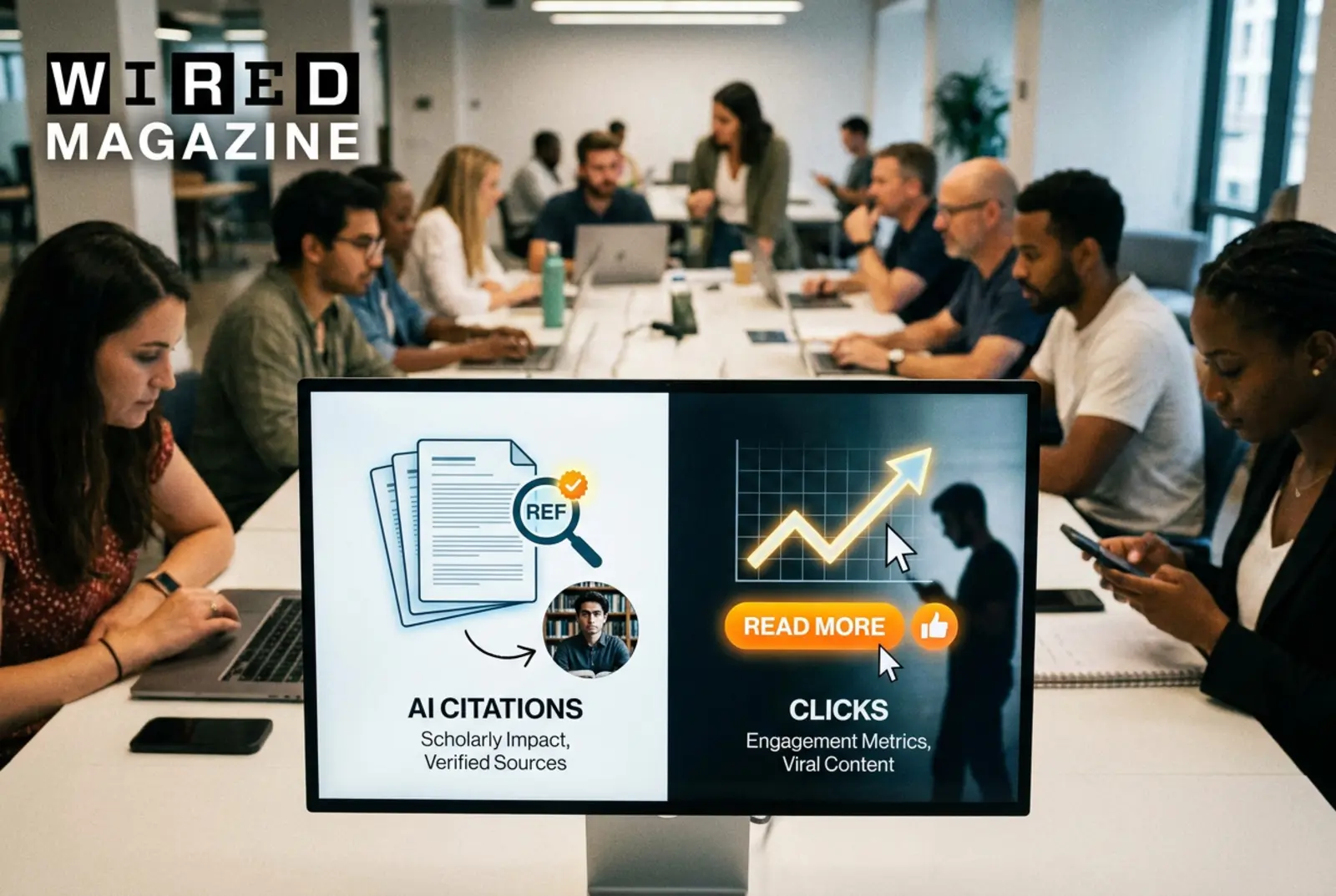
When Google shows an AI summary, users click a link inside it on just 1% of visits, according to Pew Research Center. That’s why AI citations vs clicks is the wrong fight. The 2027 B2B search scorecard tracks three things instead: how often assistants cite your brand, how many demo requests you get, and how fast branded search grows.
Your rankings went up and your traffic went down. Both numbers are telling the truth. Answer engines now settle more B2B research on the results page, so clicks fall even when your visibility rises. That’s why so many mid-market leaders are nervous about their search dashboards.
The warning has been public for a while. In February 2024, Gartner predicted that traditional search engine volume would drop 25% by 2026 as buyers moved to AI chatbots and virtual agents. Buyers didn’t stop researching. They traded legacy keyword search for full questions, and they stopped clicking.
Buyers no longer work through ten blue links to compare data platforms. They ask an assistant to read the web and hand back a summary. That zero-click answer is a different event from an organic click, so it needs a different scorecard.
Why are rankings up but traffic is going down at the same time?
I’ve spent 30 years implementing enterprise systems inside IBM, Ernst & Young, Johnson & Johnson and McKesson. In a medallion architecture, when data lands in bronze but never reaches the gold views behind Power BI, you stop and trace the flow. Search needs the same discipline right now.
We’ve seen the pattern on two mid-market sites: rankings climbed and clicks dipped anyway. We’ve also watched a team publish ten times its usual content volume and still lose clicks.
That’s the AI Overview impact on traffic in plain view. The searcher reads the summary at the top of the page, gets the answer, and closes the tab. Your content fed the answer and your brand got the credit, but the click never happened.
If you judge the program only by visits, you’ll call a working program a failure. Clicks now measure one narrow slice of your visibility.
What does the data say about AI answers and clicks?
The clearest public data comes from that Pew Research Center study, which tracked the real browsing of 900 U.S. adults in March 2025. When Google showed an AI summary, users clicked a traditional result on 8% of visits. Without a summary, they clicked on 15%.
Clicks on the summary’s own links were rarer still, at 1% of visits. A citation puts you in front of the buyer, but almost nobody clicks through.
That’s why Generative Engine Optimization (GEO) KPIs have to start with presence, not visits. An assistant isn’t a directory of links. It reads the web and writes a short briefing for the buyer. If you’re in the briefing, you’re in the consideration set. If you’re not, the buyer never hears your name.
Why do visitors sent by an assistant convert best?
Raw traffic volume is a vanity number. In our client work, visitors who click through from an AI assistant are more likely to book a demo than visitors from any other inbound source. There are fewer of them, and the pattern still holds.
The reason is the prompt itself. Someone who types “data engineering concepts” into Google skims five links and leaves. A fractional CTO who asks Perplexity to “compare Databricks lakehouse implementation requirements for a mid-market manufacturer” is deep in a buying cycle.
That buyer reads the synthesized answer first. They click a citation only when they need to validate a vendor or a method. You get fewer clicks, but each one comes from someone working on a real problem.
What belongs on the AI search scorecard for 2027?
You can’t manage what you don’t measure. At Analytics AIML, we run this through the AIM-IT Framework: Assess, Innovate, Model, Implement, Track. Assess comes first, because most dashboards still count the wrong thing.
Google Search Console folds AI Overview activity into its standard Web search totals and doesn’t break it out. It also sees nothing from ChatGPT, Perplexity or Copilot. You need a separate view.
Your analytics has its own blind spot. Visits from assistant desktop and mobile apps can arrive with no referrer, so they land in the direct bucket and the assistant gets no credit. A referral report alone will undercount the channel that is sending your best buyers.
These are the GEO metrics we put on the scorecard:
- Brand citations. How often major assistants name your company when buyers ask category questions.
- Demo requests. As clicks fall, high-intent conversions should hold or rise. That’s your proof that citations are moving buyers.
- Branded search volume. Buyers read an AI answer, see your name, then search for you directly in a new tab. This is also where unattributed assistant visits show up.
Here’s how that scorecard compares with the dashboards most teams run today.
| Scorecard | Headline KPI | What it captures | What it misses |
|---|---|---|---|
| Analytics AIML citation scorecard (recommended) | Brand citations, demo requests, branded search | Whether assistants name you, and whether that presence turns into pipeline | Needs a fixed prompt set and a baseline before trends mean anything |
| Traditional SEO dashboard | Organic clicks and sessions | Visits from classic blue links | Answers that credit your brand without a visit |
| Rank tracking | Keyword positions | Where your page sits in classic results | Whether the AI summary above it cites you |
| Google Search Console | Impressions, clicks, average position | Google exposure, with AI Overview activity folded into Web totals | AI Overview citations on their own, plus every non-Google assistant |
| Analytics referral reports | Sessions referred by assistants | Visitors who click a citation and keep the referrer | Citations that never produce a click, and app visits that arrive with no referrer |
A dashboard that still leads with sessions was built for a search era that’s ending. For the full model, see our guide to measuring AEO ROI. Comparing AI citations vs clicks moves the conversation to lead quality and pipeline velocity, where it belongs.
How does a governed data foundation support answer engine visibility?
Analytics AIML is an enterprise data platform and AI-readiness firm. We ship working pipelines on the Databricks lakehouse, not slide decks. That work taught us how assistants treat content: they reward sources that state facts plainly and consistently.
On a Databricks data engineering build, we use Auto Loader and AUTO CDC to land fresh records in bronze, clean them in silver, and govern the gold layer in Unity Catalog. Every table has an owner, a definition and a lineage. As a Lean Six Sigma Master Black Belt, I learned to define the measure before improving the process. Content is no different.
Answer engines behave like a retrieval-augmented generation (RAG) pipeline. They retrieve passages from pages they trust, then generate the answer from those passages. RAG-ready content means each section stands on its own: a question-shaped heading, a direct answer, a named source.
Entities work the same way. If your company, product and method names change from page to page, an assistant can’t resolve them to one entity, and it cites someone else. Use one definition per term and one number per metric, with its source. When your pages agree with each other, an assistant has a clean record to quote.
What needs to change in B2B content strategy today?
Stop writing generic articles built for old ranking signals. Start writing dense, factual answers to the hardest questions your buyers ask. To rank in Google AI Overviews, structure each page so a machine can lift the answer cleanly.
- Put the answer first. Place a 40 to 60 word answer block directly under each main heading. Supporting evidence comes after.
- Tune your FAQs to fan-out queries. If a CTO asks an assistant about deployment risk, your FAQ names the three main risks and how to handle each one.
- Source every claim. Back each number with a named, linked source or a real example from the field.
- Add something new. If your page repeats the top five results, an assistant has no reason to cite you.
We map out this difference in detail in AEO vs. SEO. Clarity and data discipline beat volume.
Which number will your team answer for in 2027?
It comes down to one decision: will you stop rewarding your team for low-intent traffic? Keep clicks on the dashboard as a diagnostic, but move citations, demo requests and branded search to the top line.
The harder conversation usually happens upstairs. A CFO who has watched organic sessions for a decade won’t drop them because of one slide. Run both dashboards side by side for a quarter, tie every demo request back to pipeline in your CRM, and let the leadership team see which line tracks revenue.
If your content is dense enough for the major assistants to cite, the buyers who do click arrive ready to talk. If it stays thin and unstructured, you lose both the clicks and the citations. Treat your public content with the same rigor you apply to your internal data.
Digital visibility is now a data engineering problem, and that’s the work we do. We secure the data foundation, solve the measurement problem, then scale the content that assistants trust. Secure. Solve. Scale. See how our answer engine optimization engagement works.
Frequently Asked Questions (FAQs)
How do AI agents like ChatGPT Search impact B2B lead generation compared to Google AI Overviews?
Both cut clicks, in different places. Google AI Overviews sit above the classic results, so they absorb clicks your rankings used to earn, and Search Console reports them inside Web totals. ChatGPT Search replaces the results page with a chat answer, and Search Console never sees it. In both cases, measure lead generation by citations and demo requests, not visits.
What are the most important GEO KPIs for mid-market teams?
Track three: brand citations across major AI assistants, high-intent demo requests and branded search volume. Together, they show buyer intent far better than raw traffic. Keep clicks as a diagnostic, not the headline number.
Why do citation click-through rates look so low?
The assistant answers the question on screen, so most users never need to click. Pew Research Center found that users clicked a link inside Google’s AI summary on just 1% of visits. The few who click want to validate a vendor or a method.
How does the AIM-IT Framework apply to AI search visibility?
AIM-IT stands for Assess, Innovate, Model, Implement and Track. We assess where assistants cite you today, model structured content around buyer questions, implement it, and track citations and demos instead of page views.
What is the most effective way to optimize for AI Overviews?
Lead each section with a direct 40 to 60 word answer under a clear, question-shaped heading. Answer the specific follow-up questions operations leaders ask. Support every claim with a named, linked source.