Detection engineering is usually taught as a SOC skill. On a lakehouse it becomes a data engineering discipline, with versioned rules, backtests on real history and measured alert quality.

Data & AI Engineering
NetSuite Data Warehouse on the Databricks Lakehouse
A NetSuite data warehouse on Databricks succeeds or fails on the gold model and the trial balance tie-out, not the connector. Here is how to build one that finance will sign off.
SAP Data in the Databricks Lakehouse: Business Data Cloud vs Extraction
Three ways to get SAP data into the Databricks lakehouse, compared on copies, semantics, latency and lock-in, with the process red flags to clear before you connect anything.
Splunk Alternatives: Why Security Teams Move Logs to a Lakehouse
Most Splunk alternative lists compare log search tools. Security teams under ingest-cost pressure are really choosing where their data lives. Here are seven real options and how to judge them.
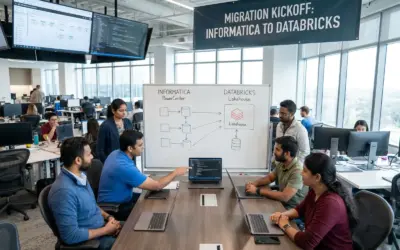
Informatica to Databricks migration: what moves and what you rebuild
Informatica to Databricks migration: which PowerCenter and IDMC mappings convert, which you rebuild in Lakeflow and how to validate.
dbt on Databricks: When It Earns Its Place on a Lakehouse
dbt and Lakeflow Declarative Pipelines both transform data on a Databricks lakehouse. Here is how to decide which one owns which layer, and how to run dbt well if you keep it.
A Data Quality Framework for the Lakehouse: Expectations, DQX and DMAIC
A practical data quality framework for the Databricks lakehouse: where Lakeflow expectations, DQX and Great Expectations fit, and how DMAIC turns rules into a control system.
Lakeflow Connect: Managed Connectors, Limits and When to Build Your Own
Lakeflow Connect gives the Databricks lakehouse managed, serverless ingestion for common SaaS apps and databases. Here is how it works, where it stops, and how to decide between a managed connector and your own build.
Teradata to Databricks Migration: A Mid-Market Playbook
A mid-market playbook for Teradata to Databricks migration: sizing the estate, converting BTEQ and stored procedures, moving data with TPT, reconciling results and knowing when you are ready to cut over.