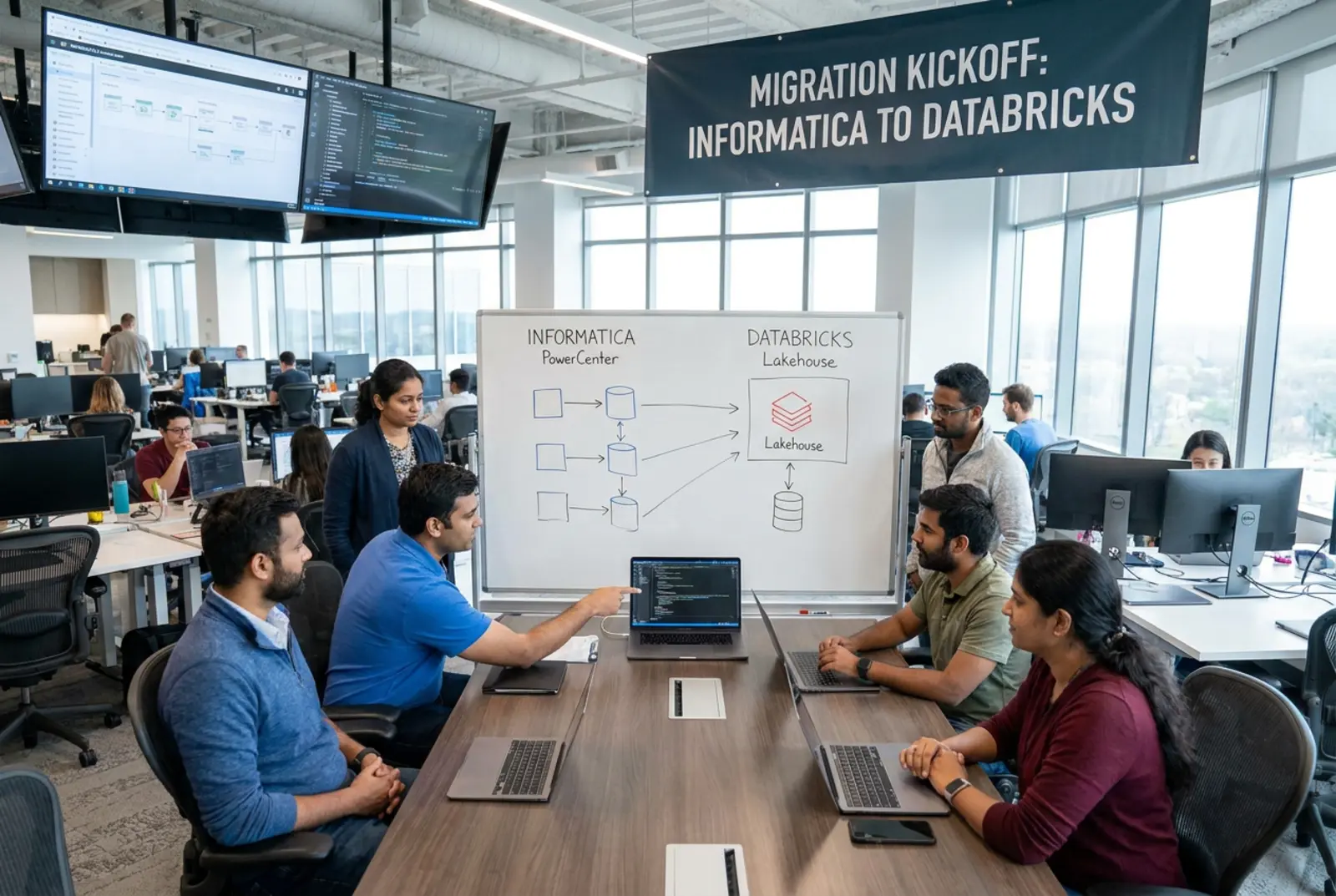
An Informatica to Databricks migration splits your estate into two piles. Source-to-target loads, filters, expressions and standard SQL overrides move to the lakehouse with light rework. Lookups, Update Strategy logic, custom Java code and shell-script workflows get rebuilt natively in Lakeflow. Convert the first pile and rebuild the second.
In 30+ years of Fortune 500 consulting, the pattern holds: the mappings are rarely the real problem. The problem is the years of workarounds wrapped around them, such as watermark tables, pre-session scripts and lookups cached row by row because the server had no better option.
That debt has a price. CIOs surveyed by McKinsey estimate that tech debt amounts to 20 to 40 percent of the value of their entire technology estate before depreciation. A naive lift-and-shift moves that debt to the cloud and bills you for it every month. It also stalls your generative AI work, because an LLM or an agent can only reason over data it can find, trust and trace back to its source.
The target is a medallion architecture, with bronze, silver and gold layers on open Delta tables. Getting there takes discipline. Inventory what you have, retire what you don’t need and rebuild what matters.
| Migration approach | Speed to first pipeline | Technical debt cleared | Native Lakeflow features used | Best fit |
|---|---|---|---|---|
| Hybrid: convert the simple, rebuild the complex | Moderate | High on the pipelines that matter | Full on rebuilt pipelines | Most mid-market and enterprise estates |
| LLM-assisted and automated ETL converters only | Fast | Low, legacy row-by-row patterns carry over | Minimal | Large estates of simple source-to-target loads |
| Full manual rebuild | Slow | High | Full | Small estates or a complete redesign |
| Lift-and-shift to cloud VMs | Fast | None | None | A data center exit on a hard deadline |
Why are enterprise data teams leaving Informatica?
Licensing is the first driver. Legacy ETL licensing ties cost to capacity, through server cores for PowerCenter and Informatica Processing Units for IDMC. Every new pipeline starts with a capacity conversation instead of an engineering one.
Elasticity is the second. A fixed PowerCenter grid sized for month-end close sits idle most of the month. Databricks job clusters start for the run and shut down when it finishes, so you stop paying for idle hardware.
Readiness for generative and predictive AI is the third, and it forces the decision. GenAI data pipelines and reliable agentic workflows need open, governed data with metadata every tool reads. You can’t build that on proprietary pipelines your data scientists can’t see into.
Running integration on one platform and data science on another doubles the handoffs. Analytics AIML applies first principles thinking to Databricks data engineering for exactly this reason: one platform, one governance model and fewer copies of the same data.
How do PowerCenter and IDMC concepts map to Databricks Lakeflow?
PowerCenter and IDMC express logic as a visual chain of objects. Databricks expresses the same logic as SQL or PySpark inside Lakeflow Declarative Pipelines (formerly Delta Live Tables), orchestrated by Lakeflow Jobs. Nearly every object has a direct equivalent.
| Informatica object | Databricks equivalent | Moves cleanly or rebuild? |
|---|---|---|
| Source Qualifier (files) | Auto Loader into bronze | Moves cleanly |
| Expression | Derived columns in a SELECT | Moves cleanly |
| Filter | WHERE clause | Moves cleanly |
| Router | Several pipeline tables, each with its own condition | Moves with restructuring |
| Aggregator and Joiner | GROUP BY, window functions and JOIN | Moves cleanly |
| Sequence Generator | Identity column on a Delta table | Moves cleanly |
| Connected and unconnected Lookup | JOIN, broadcast join for small dimensions | Rebuild |
| Update Strategy (SCD Type 2) | MERGE INTO or AUTO CDC | Rebuild |
| Mapping parameters, variables and parameter files | Job parameters, bundle variables or a Delta control table | Rebuild |
| Custom Java logic, Mapplets, shell scripts | Python functions, shared modules or job tasks | Rebuild |
| Workflows and sessions | Lakeflow Jobs | Rebuild |
Auto Loader replaces the Source Qualifier for file ingestion into bronze. It tracks which files it has already processed, so the custom watermark tables your Informatica jobs depend on go away. When a new column appears, Auto Loader records it in the schema location and picks it up when the stream restarts.
Row-level logic moves cleanly: an Expression becomes derived columns in a SELECT, and a Filter becomes a WHERE clause. A Router becomes several pipeline tables reading the same source. An Aggregator becomes a GROUP BY or window function that runs across the whole cluster.
Lookups are the biggest architectural shift. Informatica caches lookup tables and probes them row by row, and unconnected lookups get called from inside expressions. On Databricks, rebuild each one as a join, and turn small dimension tables into broadcast joins that ship to every worker once.
Update Strategy logic for slowly changing dimensions disappears. Delta Lake’s MERGE INTO handles inserts, updates and deletes in one statement. For change feeds, AUTO CDC orders events with SEQUENCE BY and maintains SCD Type 1 or Type 2 tables for you.
Our guide to Databricks Lakeflow pipelines shows how these patterns fit the bronze, silver and gold layers.
Should you use automated converters or rebuild from scratch?
Use both. Converters, whether rule-based or LLM-assisted, earn their keep on simple work: straight source-to-target loads, plain SQL overrides and standard data type conversions. If you have hundreds of staging mappings, a converter handles them in bulk.
Converters fall down on proprietary debt. Informatica to PySpark translation of custom Java code, pre- and post-session shell scripts and deeply nested Mapplets comes out unreadable. Worse, the output often mimics row-by-row processing, so the new job runs no faster than the old one.
Our approach is hybrid. Run a converter to inventory the estate and translate the genuinely simple pipelines. Rebuild the critical business logic natively, with AUTO CDC, materialized views and version-controlled code in Databricks Asset Bundles.
Our breakdown of modern ETL tools explains where converted code stops paying off and native pipelines take over.
How do you keep data quality and lineage after the move?
In most Informatica shops, lineage lives in a separate product such as Enterprise Data Catalog, refreshed by periodic scans. On Databricks, Unity Catalog becomes the governance layer for tables, files and machine learning models.
Unity Catalog captures lineage at runtime, down to the column level, for queries on Unity Catalog-enabled compute. Change a silver-layer step and you see every downstream gold table, view and notebook it touches. Governance stops drifting out of sync with the data.
Data quality moves into the pipeline itself. Lakeflow Declarative Pipelines define quality rules as expectations, and each one either logs, drops or fails on bad rows. The results land in the pipeline event log, where you query them like any other table.
If your workspace still runs on the legacy Hive metastore, plan the Unity Catalog upgrade as part of the migration. The Databricks Labs UCX toolkit assesses the workspace and automates most of the table upgrade. The real work is the access model, which moves from path-level permissions to centralized grants on catalogs, schemas and tables.
Our post on data lineage covers what good lineage looks like once that model is in place.
Where do Informatica migrations stall?
Three problems slow most Informatica moves more than the code does. None of them shows up in a converter’s output report.
- The skill gap. PowerCenter developers built logic in a visual Designer. On Databricks the same logic lives in SQL or PySpark, in Git and in Databricks Asset Bundles. Start your Informatica developers on SQL-defined pipelines, where their join and filter instincts carry over, and pair each one with a Python engineer for the first rebuilds.
- Mapping variables and parameter files. Informatica feeds run-time values through parameter files and persists mapping variables, such as a last-run date, in the repository. On Databricks, static values become job parameters or bundle variables set per target, and persisted watermarks become Auto Loader checkpoints or a small Delta control table.
- The cost of running twice. Parallel validation means paying for Informatica licenses and Databricks compute in the same months. Keep the parallel window short, run comparisons on job clusters that shut down after each check and plan the cutover against your license renewal date.
What does a phased migration plan and validation look like?
We run every migration through the AIM-IT Framework: Assess, Innovate, Model, Implement, Track. At Analytics AIML, a Lakeflow build is a process improvement project first and a code project second, run with Lean Six Sigma discipline.
Assess starts with the Informatica repository. Find dead mappings, unused targets and redundant staging tables, then retire them. It is Lean Six Sigma waste removal applied to pipelines: every obsolete pipeline you migrate is a cost you pay twice.
Innovate and Model define the target medallion architecture. We lay out Unity Catalog catalogs and schemas, size the compute and build standard Auto Loader ingestion patterns. Engineers then reuse one template instead of inventing a new structure for every table.
Implement runs old and new side by side. Lakeflow pipelines run alongside the Informatica workflows, and we compare gold outputs with row counts, checksums and KPI parity tests. Reports keep reading from Informatica until cutover, so the business sees no reporting downtime during the build.
Track closes the loop. Informatica stays on until the outputs match across consecutive month-end closes. Then you decommission the servers.
What should you ask before you migrate your Informatica pipelines?
Treat the move as legacy ETL modernization of your data operating model, not a vendor swap. Ask your engineering leads three questions before you sign off.
- Which pipelines are we converting, which are we rebuilding, and why?
- How will we handle complex historical logic, parameter files and slowly changing dimensions?
- What will governance look like under Unity Catalog compared with today?
If the answers describe lifting old habits into the cloud, stop and rescope. The goal is predictable performance on open formats, with lineage you trust.
Analytics AIML builds production lakehouse architectures that replace licensing bottlenecks with elastic compute. Secure. Solve. Scale. When you’re ready to map your Informatica estate, start with our lakehouse migration approach.
Frequently Asked Questions (FAQs)
Are there automated tools to convert Informatica PowerCenter to Databricks PySpark?
Yes. Rule-based and LLM-assisted converters read PowerCenter mapping exports and generate PySpark or Spark SQL. They handle straight loads, filters and expressions well. Expect to rewrite custom Java, unconnected lookups and Update Strategy logic, and validate every converted job against Informatica output before you trust it.
How do you handle Informatica mapping variables and parameter files in Databricks?
Map each parameter file to job parameters or Databricks Asset Bundle variables, with one value set per target such as dev, test and prod. Mapping variables that carry a value between runs, like a last-run timestamp, become Auto Loader checkpoints or a Delta control table the pipeline reads and updates.
What happens to our Informatica SQL overrides?
Standard SQL overrides move with light edits, because Spark SQL covers most ANSI syntax. Dialect-specific code needs a rewrite. Oracle CONNECT BY queries, ROWNUM filters and vendor optimizer hints need the most attention.
How does Databricks handle change data capture compared with Informatica?
Lakeflow Declarative Pipelines use AUTO CDC, formerly APPLY CHANGES INTO. You declare the key, the ordering column with SEQUENCE BY and the SCD type. The pipeline sorts out-of-order events, applies deletes and maintains Type 1 or Type 2 history without hand-built update strategies.
Can we migrate the Hive metastore to Unity Catalog during the Informatica move?
Yes, and we recommend it. Upgrading during the migration means every new pipeline lands in Unity Catalog with column-level lineage from day one. Hive metastore federation covers any tables you upgrade later.